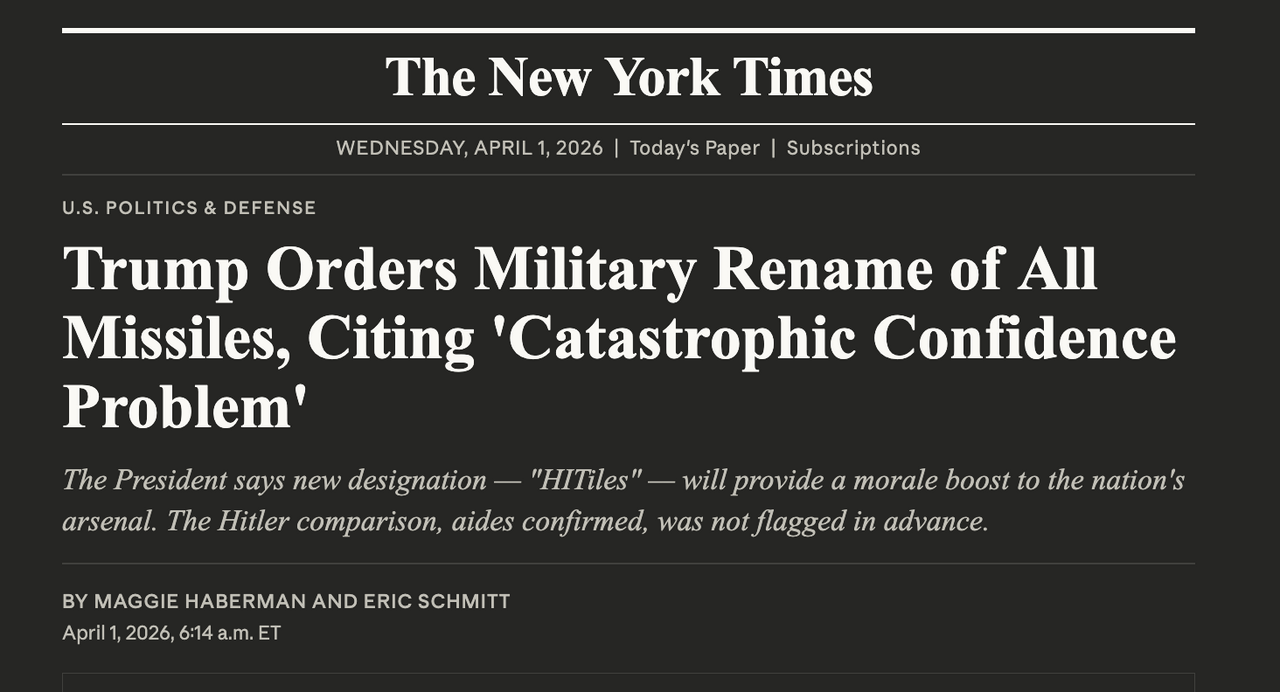
Trump Orders US Missiles To Be Renamed
President Trump at a briefing on Tuesday, where he announced what the Pentagon is privately calling “the nomenclature initiative.” Credit: Doug Mills/The New York Times
WASHINGTON — President Trump signed an executive order on Tuesday directing the Department of Defense to rename all American missile systems, declaring the word “missile” a threat to national security on the grounds that it implied, in his words, “a total loser attitude from day one.”
Under the directive, which takes immediate effect, all weapons currently classified as missiles will henceforth be designated “HITiles” — a portmanteau the President said came to him “during a very productive executive hour” and which he described as “maybe the best branding I've ever done, and I've done a lot of great branding.”
“Why burden these weapons with low confidence by calling them MISSiles? It's dumb. Ours will be called HITiles. What a boost that'll be to their self esteem.”
Speaking to reporters on the South Lawn, Mr Trump elaborated on the philosophical foundations of the policy. “Look at Hitler,” he said. “Do you think he'd have got anywhere if he'd been named Missler?” The remark prompted an immediate and ongoing response from historians, ethicists, the German Embassy, and the Republican Party's communications director, who was seen briefly leaving the building at a brisk walk.
The Pentagon confirmed it had received the order and was “assessing implementation timelines.” A senior defense official, speaking on condition of anonymity, said renaming approximately 30 distinct weapons systems would cost an estimated $2.4 billion in rebranding, signage, and software updates. The President, when informed of the figure, reportedly said it was “worth every penny” and asked whether the HITile logo could be gold.
NATO allies have not yet formally responded. A spokesperson for the alliance said members were “monitoring the situation,” which diplomatic observers described as “thunderous understatement.”
The White House did not respond to a request for comment on whether the executive order had been reviewed by legal counsel, the Joint Chiefs, or anyone with a background in twentieth-century European history.